a metaphorical molotov.

bear with me here

January 29th, 2010 by CharlesB

Hey folksies. My names Charles. I’ve been lurking on and off here for quite awhile and finally got around to joining this excellent community of quality folk. And thus I have to introduce myself.

But let’s preface some of the particulars of where I come from and where I’m going with a much more fun sense of who I am.  I’m a very vocal, people oriented person. I love good conversation and do most of my best thinking vocally while in dialogue with others. Which unfortunately means I’m not a very good writer (hello, text ridden blog world), so part of what excites me about YAR here is a chance to engage in dialogue with intelligent people in a new medium, I think I’ll find that stretching. I like to laugh, I like to smile and I’ll hug just about anyone (though  I’m now getting better at recognizing appropriate hug settings :P). I enjoy good beer, fine wine, nerdy boardgames and plenty of other geeky activities (especially those involving other people).

I’m a Mennonite and was raised as such. I spent about six years in the Mennonite education system graduating from Goshen with a degree in Bible/Religion. And I’m going back in the fall for an MDiv from AMBS. I just can’t escape. read more »

Anawim Theology and Avatar

January 28th, 2010 by SteveK

Anawim theology is the biblical theology of God’s salvation of the poor and outcast. It is strongly linked to anabaptist theology. “Anawim” is a Hebrew term that means “the poor seeking the Lord for deliverance”, is used in the Psalms extensively and is referred to in the Magnificat and the Beatitudes. If you are interested in reading a popular theology of it you can read the book Unexpected News: Reading The Bible Through Third World Eyes or check out this website: http://www.nowheretolayhishead.org/teachings.html

But I’m not here to talk about that. I’m here to talk about Avatar.

I understand that some feel that there is some racism in Avatar, and I can see their point, but it would be deeply embedded and certainly not obvious to the masses throughout the world watching it. However, I believe that part of the reason that Avatar is so popular is because of the open Anawim-like theology involved. There is a general morality throughout the world that the underdog should be supported and that God is on the side of the oppressed. Avatar not only supports this, but has a pretty strong morality/spirituality. As I sat and watched it a couple times, I wrote the following principles down that I think describes Avatar’s basic support of Anawim theology:

There is a empire, ruling the world, and its focus is to increase the wealth of a limited few, even if that hurts others. Everyone within the empire is a part of this system of greed, even if they superficially attempt to oppose it. read more »

James Brenneman, J. Lawrence Burkholder and a new Mennonite theology of “loyal opposition” for Goshen College

January 25th, 2010 by TimN

crossposted from As of Yet Untitled

Blest with vict’ry and peace, may the heav’n-rescued land
Praise the Pow’r that hath made and preserv’d us a nation!
Then conquer we must, when our cause is just,
And this be our motto: “In God is our trust”
- Francis Scott Key, Start Spangled Banner, 1814

Happy 4th of July! The American Flag in Fireworks by Beverly & Pack, flicrk user walkadog

Last week my alma mater, Goshen College, announced that it would begin playing the Star Spangled Banner at sporting events. Their press release frames the decision as an exciting new theological and socio-political adventure for the college. Make sure to read the press release especially the quotes from GC president James Breneman and the GC Presidential Council.

I should say up front that this issue is fairly new to me. I wasn’t much of an athlete, so the playing of the national anthem was not an issue for me growing up. For a thoughtful perspective on GC’s decision from someone who has thought about this all their life, read a Open Letter to GC from Britt Kaufmann, longtime Mennonite athlete, coach and GC alum.

I’m mainly interested in this decision because of the way it was rolled out as part of a broader vision emerging from GC President James Brenneman. See his recent sermon Brenneman calls for new ’school of thought’ at Goshen of positive engagement in the world.

read more »

Anabaptist Rosary

January 21st, 2010 by AlanS

As a note: This is also posted at The Wandering Road

So I’ve recently run across the Catholic Rosary.  While I’m drawn to it’s structure and it’s ability to help people pray, as a good Anabaptist, I take issue with some of it’s theology.  So here is my initial thoughts and proposal for an Anabaptist Rosary.

First- An orientation to the actual Rosary.

How to pray the Rosary
1. Make the Sign of the Cross and say the “Apostles Creed.”
2. Say the “Our Father.”
3. Say three “Hail Marys.”
4. Say the “Glory be to the Father.”
5. Announce the First Mystery; then say
the “Our Father.”
6. Say ten “Hail Marys,” while meditating on the Mystery.
7. Say the “Glory be to the Father.”
8. Announce the Second Mystery: then say the “Our Father.” Repeat 6 and 7 and continue with the Third, Fourth, and Fifth Mysteries in the same manner.
9. Say the ‘Hail, Holy Queen’ on the medal after the five decades are completed.
As a general rule, depending on the season, the Joyful Mysteries are said on Monday and Saturday; the Sorrowful Mysteries on Tuesday and Friday; the Glorious Mysteries on Wednesday and Sunday; and the Luminous Mysteries on Thursday. read more »

Listening to Martin Luther King, Malcolm X and James Cone

January 18th, 2010 by TimN

Crossposted from As of Yet Untitled.

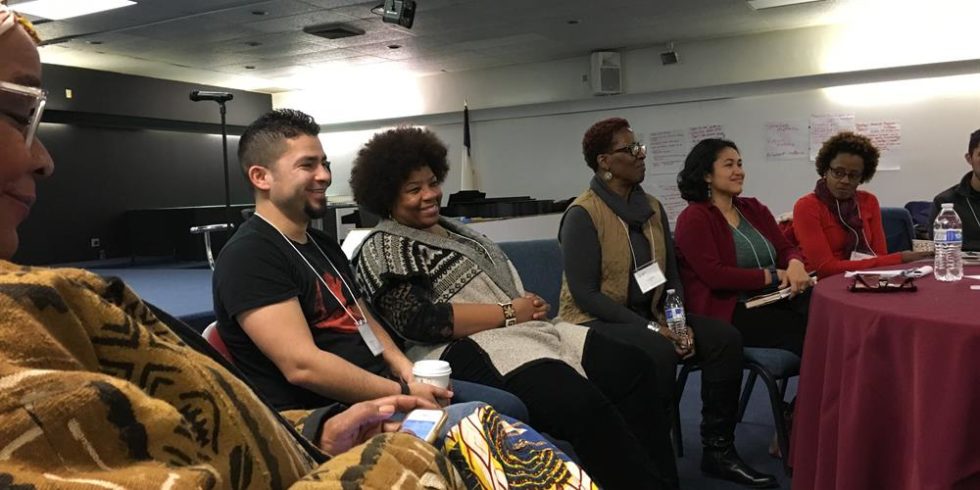
Last evening I sat around our living room with 22 other Living Water Community Church folks and had a frank conversation about racism. The conversation was passionate and open. It ranged from personal stories to talk of definitions of racism and even touched on the practical. It was a new conversation to have with so many people in our congregation. My hope is that our sharing together will the start of a serious process that will include our whole church and not just a one Sunday event in honor of Dr. Martin Luther King Jr.

As most of you well know, the vision of Martin Luther King was not simply dreams of black and white children playing together. It was not just about sitting down and being friends. Some of us have heard of his radical critique of the triple evils of poverty, racism and war. But in Malcolm & Martin & America: a Dream or a Nightmare?, James Cone goes far beyond the quotes and the sound bites to look at the grain of King’s life and shows how his life path and vision was and is inextricably linked with that of Malcolm X.

I highly recommend Malcolm & Martin & America for Christian who recognizes that the problem of racism in the United States did not go away with the election of Barack Obama. It is a surprisingly readable history that tells the story of both men in the context of the history of black nationalism and integration struggles. I’m not qualified to write an overall review of the book, but I will share a few quotes from the book that stood out for me along with a few of my own thoughts.

read more »

Blessing of the Animals

January 17th, 2010 by RustyP

Your justice is like the unending mountains,
your judgments like the great deep;
human and beast the Lord preserves!

Psalm 36:5-6

Today is the annual Blessing of the Animals. This holiday has taken on many forms and is incorporated throughout many traditions, but it was started by St. Francis of Assisi, who had a deep connection with the wild and with non-human animals. For those unfamiliar, St. Francis was the son of a wealthy Catholic family in Assisi. He was sent to war, yet quit and returned home early with a drastically different outlook on life. He refused to kill and began questioning everything. He spent time living in the wild with the animals and swore that they taught him things. He publicly renounced all material possessions. The rest of his life would be dominated by feral, simplistic solidarity with the peasants and animals- the human and non-human ‘beasts’ of Assisi.

There is not a lot of space for ritual within our culture, and since most religious traditions are products of our culture, there doesn’t seem to be lot of room for ritual within our churches either. Catholics and Episcopals still celebrate the Blessing of the Animals, yet the Protestant denial of the material has led most Christian churches to stay away from valuing the ‘things of this world.’ Most Protestant churches, especially evangelical ones, tend to be stripped of statues, art, candles, incense, or anything else material. ‘Scripture only’ and ‘faith alone’ doctrines have led to a rejection of anything that might aid the process of spiritual development for fear that it would do the opposite and become an idol or a replacement for that which only God can be. Yet this radicalism has led to a spiritual philosophy void of meaning, where the advice of pastors become, “Just leave it to God,” or “Just read your bible.” Ritual was central to the Jewish tradition. Jesus did not challenge ritual, but the attempt of the religious authorities to strip ritual of it’s proper meaning. When he turned the water into wine, he was doing something very profound. The water at a Jewish wedding was most likely used to wash, which was not primarily a sanitary concern, but a purity ritual. It’s my belief that Jesus intentionally took the water away and turned it into wine to challenge the religious leader’s idea of purity. He turned it instead into a wine, which is a drink commonly shared with friends and families during celebrations, bringing life and spirit to the occasion. read more »

Invitation from Mennonite Publishing Network to help revision resources for 20 and 30-somethings

January 11th, 2010 by admin

This is a invitation to the YAR community from Byron Rempel-Burkholder, and editor at Faith and Life Resources/Mennonite Publishing Network. Feel free to contact Byron directly or leave your response in a comment.

We at Mennonite Publishing Network need your help in creating resources that nurture spirituality among 20- and 30-somethings. Our traditional existing medium is Rejoice! magazine, which offers daily meditations on Bible texts, along with denominational prayer requests. Rejoice! is relatively successful among middle and older adults, but it is attracting only a small segment of younger adults to its readership. read more »

Can you help out a YAR community member in need?

January 4th, 2010 by TimN

Jason Barr's house burning

I returned to work to work today to find an email about the complete destruction of my friend Jason Barr’s home over the holidays. Jason and his wife Gretchen didn’t have insurance, so their depending on good old Anabaptist mutual aid to recover from a loss of just about everything they owned in the fire (that’s their apartment burning in the photo above). If you can give them a few dollars to help them rent a new place and replace their stuff, it would be much appreciated:

Please give to support Jason and Gretchen

For those of you who don’t know Jason personally, he has been involved in Anabaptist circles for a number of years thinking and sharing about Christ-archy. read more »

Spiritual Practices for the New Decade

January 2nd, 2010 by ST

There is a fair amount of change on the horizon for me as a YAR. I seek to face the changes with a soundness in mind, body, and soul. When I look back at the times when I was the healthiest and times I was the unhealthiest………I see that one factor is whether or not I was doing one or more spiritual practices.

Do you have any spiritual practices (sometimes called spiritual disciplines or spiritual exercises) that you hope to pursue this next year or the next decade?

I’m thinking about the ones that I hope to do this year (or at least for the next little while) and my challenge is also to “not pick too many”.

Levi Miller, peace and justice and the Mennonite chattering class

December 14th, 2009 by TimN

crossposted from As of Yet Untitled

Dried Love in the Mist seedpods

For the last few weeks, I’ve been wrestling with how to respond to Levi Miller’s column on "peacenjustice". My first reaction was one of anger and frustration. No wonder the Mennonite church has had such a hard time integrating peace and justice into our whole denomination! The director of our publishing house mocks it as a buzzword and sees it as a product of "cultural chatterers." Miller seems to see shalom (the bible’s word for peace and justice) as a little more then a worn out fad. It was much loved by the Sandinistas and Sojourners in the ’70s, but it is time to grow up and move on.

Over the weeks, I wrote several paragraphs expounding on my outrage at an old white guy maligning a theology of liberation that challenges the unjust status quo.

read more »

Book Review: The Holy Spirit by Ivan Satyarata

December 12th, 2009 by folknotions

The Holy Spirit: Lord and Life-Giver
Ivan Satyavrata
InterVaristy Press
April 2009
ISBN: 978-0-8308-3307-8
IVP
Amazon

It’s a bit of a low blow to poorly review a literary/artistic work when you are charging it with not being what you expected it to be.  For example, when I was 8, my art teacher asked us to draw and color…I think it was a landscape. Now I have never really been a great artist, mostly because I’ve been colorblind since birth (though I did have a brief phase during my adolescence in which I won a prize from a local art gallery for my pencil and black ink rendering of some shadowy, comic book-esque superhero). So when it came time for me to draw a landscape, and I spent the time grabbing any color I felt like and making scribbles all over the place, when our work was done my teacher kicked me out of class, called my mother, and had a conference that afternoon. She told my mother that my work was unbecoming of an eight-year old. My mother blinked at her and said “what’s becoming of an eight year old in art class?”

The story is not directly equivalent, but the meaning shines through ( I hope): it’s not fair for me to set expectations for Satyavrata’s book- that he had no intent of keeping - and then criticize him for not doing so. However, the marketing of this book has made it particularly difficult not to. read more »

“New Monkery”

December 6th, 2009 by Ben_jammin

My father is doing research on the history of Anabaptist in Augsburg, Germany, the town the Confessio Augustana was proclaimed in 1530, in which the new Lutheran church proclaimed its faith and also some condemning of Anabaptists. The dialogue between Lutherans and Mennonites is still suffering from this. During World Conference Assembly in Asunción this year Ishmael Noko said “[the Lutheran church] is like a scorpion, we still have this poison [the articles about condemning Anabaptists] we just didn’t use it for a long time, but it’s still there” Recently the Lutheran World Federation officially apologized.

But that’s actually not what I wanted to write about. Augsburg was also a major Anabaptist center in the 16th century. That’s why the local reformator Urbanus Rhegius wrote a pamphlet “against the new baptist order” in which he claims that the Anabaptists are actually just a “new monkery”, an argument made in many writings against the Anabaptists. The claim is that they only make the same things as the monastic orders did, just with families.

I don’t know too much about the New Monasticism movement, I read Shane’s first book, but I guess the name wasn’t knowingly a reminiscence on the Anabaptists.

Minarets, church towers and Babel

December 6th, 2009 by Ben_jammin

British anti-minaret posterSwiss anti-minaret posterI don’t know whether in the States you have noticed the debate about the Swiss people’s decision last Sunday (29th of November) to amend their constitution to forbid minarets. Here in Germany and the rest of Europe fascists and right-leaners are celebrating and want plebiscites on these issues as well(check out their posters!). Swiss politicians are shocked as no one would have anticipated such a result and are now checking if they can squirm out of it, by saying that basic liberties cannot be changed, not even by the will of the people. Analysis shows that the most votes for the ban came from the rural areas where there are almost no Muslims, and most votes against the ban came from the cities where there is a relatively high Muslim population, still not high. In all of Switzerland there are four mosques…

To me, this shows a fundamental flaw in democracy as good as it maybe: Democracy does not mean the rule of people, it means rule of the majority and if the majority should decide not to tolerate the minority -like the case with Switzerland - so be it. Ok, in order to correct this there are things like independent judges and not directly elected secretaries, but that is exactly what the SVP, the “Swiss People’s Party”, wants to change next. Democracy is not an absolute value.

But how is the Anabaptist view on this, is there one at all? In the beginning, Anabaptists didn’t gather in fancy churches, they met in houses or caves in the forest to prevent being sent to prison. The only time one would find them in the usual churches was to storm the pulpit and preach the gospel. When Anabaptists were allowed to settle in Southern Germany after the 30 years war they weren’t allowed to build church towers.

The bells in church towers have often been melted in times of war to make swords and guns, a reversion of Micah 4,1-4 so to say.

During the campaigning for the ban on minarets the initiators always claimed not to be anti-Islamic, but that they were only against radical Islamists and that Islam didn’t need minarets, therefore a  minaret was a political extremist statement and it’s ban would not interfere with the right to religious freedom.

Let’s look at Christianity then, I did find one story in my Bible, where people wanted to build a tower. But after God “came down to see the city and the tower that the men were building” Gen.11,5 he didn’t like it too much and confused their languages.

In the New Testament there is not a single reference of towers… So, are towers needed in Christianity? Shouldn’t the Swiss people perhaps also ban church towers?

Or maybe Swiss Mennonites and Mennonites in general should build “mennorates” in solidarity with the Swiss Muslims?

Introducing Ben_jammin

December 6th, 2009 by Ben_jammin

Greetings, my fellow YARs!

As I am the newest and probably youngest contributor to this community blog, I thought before posting stuff here I should introduce myself.

I am seventeen (thus I think I have proven to be young) and I am a Kraut, as American G.I.s came to call Germans, when they occupied Germany after liberating us from fascism, although I rarely eat kraut at all. I was born into a Mennonite intentional community in a small town, which is why I always somehow found it funny when people are so amazed by community living - for me that’s everyday life.

The Anabaptist tradition has been passed along to me by my parents and still I think I can still call myself radical, because I chose it myself in my baptism and everyday life.

My hobbies are rather nerdy: reading, playing chess, Pen&Paper games (I am still working on an Anabaptist P&P set in the 16th century…) and peace.

What more is there to say: Oh yes, the military just sent me a letter, that my examination will be next summer and that I would have very good career options if I became a sergeant (in Germany we have a draft).

Hello, I am glad to be here.

Prayer Warriors

December 5th, 2009 by ST

Please, I am wondering if anyone knows of a less militarized way of labeling a group of people who commit to praying for an event or process. I am gathering a group of people to give SERIOUS prayer support to the process of pastoral transition at church. Traditionally, the term “prayer warrior” has been used. I like the sense of commitment, power, authority, determination, and passion that this label carries, but it is just too violent. Warriors kill and train to dominate and decimate their enemies. We are pacifists and so need a better term…one that connotes all these qualities above but isn’t war-like. read more »