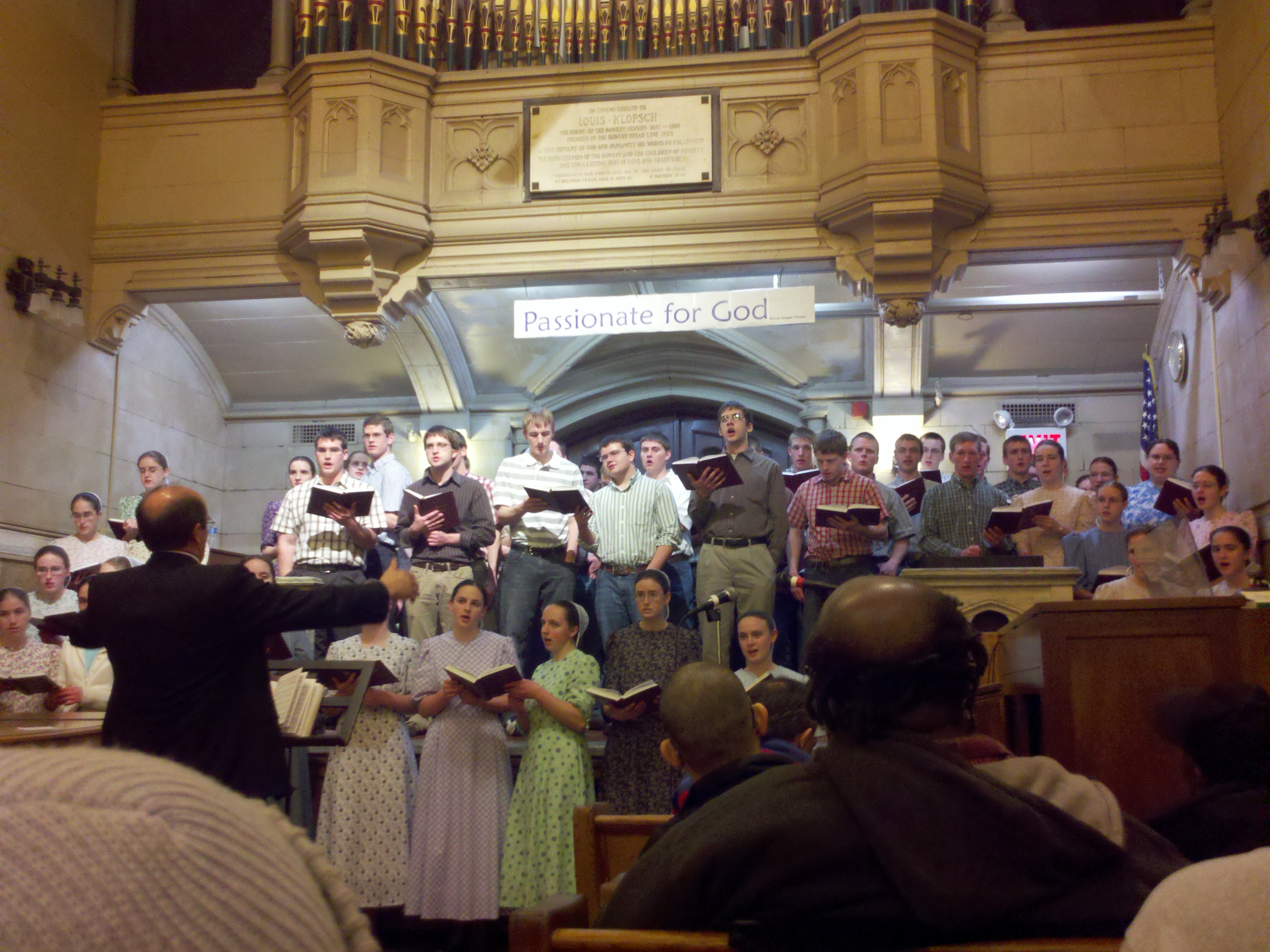
There’s a building boom on the Bowery these days. It’s been happening for a while, but the last couple years have witnessed an escalation in development, turning the neighborhood into a hip destination point.
Fifty years ago the Bowery was the largest skid row in the world. There were gin joints and flophouses on every block. That’s all gone now, thanks to the forces of gentrification. In their place are condos, art galleries and upscale eateries. Only one skid-row relic remains: the Bowery Mission.
Some of my earliest memories are of sitting behind the Mission’s pulpit in the 1960s, looking onto a sea of expectant faces while my father preached. In retrospect I realize the men behind those faces were awaiting the sermon’s conclusion so they could get their grub. (more…)
In January I saw an article in the Wichita Eagle about a woman who was thoroughly convinced that the rapture and the end of the world would be on May 21, 2011.  At 6pm to be exact.  Well, this Saturday is the fateful day and, as one would expect, the story has been picked up by various news outlets.
Now forgive me if I sound a little cynical, but I know my history. Â From the very first moments that Jesus walked the earth people have been predicting his return, and thus the end of the world with it. Â So far, no one has been right.
What’s more, I know what happened at Münster.  To recap, a group of Anabaptists violently took over the town of Münster and swiftly began killing people, running around naked and doing a whole bunch of other things all because they were certain that Jesus was coming back right then and there.
Is Gandhi in hell?  What’s more, what is hell?  Or heaven, for that matter?
These are some of the questions that have sparked a bit of a firestorm around Rob Bell’s new bookLove Wins: a book about heaven hell and the fate of everyone who ever lived.  This first came across my radar screen when I read a post on Tony Jones’s blog late last week about the growing attention and criticism about this book.  Then I did some searching and saw that it has even made a splash on the national news scene from CNN to ABC.
Here’s the book promo video:
Controversy in and of itself isn’t surprising with Rob Bell.  That’s happened before.  What is striking is that judgment has been leveled by a number of people who haven’t even read the book yet because it has not yet been released!
Ultimately the controversy stems from the fact that Bell is raising core questions about issues that are central to the Christian faith.  He has posed the questions in ways that have led some to conclude that Bell is promoting something called Universalism; a doctrine where everyone gets saved, no matter what.  Again, these are all assumptions because none of his critics have actually read the book yet.  The only worthwhile critique I’ve read so far is Greg Boyd’s, namely because he actually has read the book.  (As a side note, as an Anabaptist, it’s worth paying attention to Boyd partly because he’s grown very close to Mennonites in recent years, even flirting with the idea of joining MCUSA.) (more…)
As I was standing in the shower this morning, pondering the latest news story about the new Travel Safety Administration (TSA) search procedures, I came up with an interesting, Biblically based, idea about how one might go about resisting these new invasive search procedures.
Strip for the TSA
Follow me for a second and I’ll tell you what I mean.
Background
The TSA has now upped the game when it comes to air travel. They are introducing new full body scanners which virtually remove all of your clothes and allow the TSA agents to see everything. And I mean everything. If you don’t want to submit to this scan then you can opt for the new enhanced pat down which involves, among other things, actually touching your genitals. Here’s the catch. Once you have gotten yourself into this situation and didn’t want to do either one, one would assume that you would be able to simply say, ‘no thanks, I’ll walk to California’ and leave the airport. Not so fast. It’s against federal law to leave the security screening process one you have started it, therefore if you choose to refuse both of these methods of search, you are subject to a $10,000 fine and/or a civil lawsuit  (All of this was brought to a head by the experience of John Tyner) So what that means, is that anyone who is traveling through a major city, has the chance of being stuck in a situation where you two apparent options are 1) be violated or 2) face fines and lawsuits.
As part of the conversation that often occurred in response to Mennonites in Northern Ghana, who were asking me “what does it mean to be Mennonite?” I would quote a snippet from Menno’s document. (I mean, only sometimes, when they asked specifically about Simons, because “church founders” are a BIG deal there). But the language was such that I always found myself changing the words. These folks loved Jesus, and they weren’t necessarily asking me about what Jesus had to say about discipleship and prayer, but they wanted to know what Menno had to say. They had only relative familiarity with British English and most are distanced from the written word. I wonder if I translated the following accurately? I wonder if it matters? How would you translate/summarize this part of Menno Simon’s Why I Do Not Cease Teaching and Writing (1539)
“True evangelical faith is of such a nature that it cannot lie dormant, but manifests itself in all righteousness and works of love; it dies unto the flesh and blood; it destroys all forbidden lusts and desires; it seeks and serves and fears God; (more…)
So I’ve recently run across the Catholic Rosary. While I’m drawn to it’s structure and it’s ability to help people pray, as a good Anabaptist, I take issue with some of it’s theology. So here is my initial thoughts and proposal for an Anabaptist Rosary.
First- An orientation to the actual Rosary.
How to pray the Rosary
1. Make the Sign of the Cross and say the “Apostles Creed.”
2. Say the “Our Father.”
3. Say three “Hail Marys.”
4. Say the “Glory be to the Father.”
5. Announce the First Mystery; then say
the “Our Father.”
6. Say ten “Hail Marys,” while meditating on the Mystery.
7. Say the “Glory be to the Father.”
8. Announce the Second Mystery: then say the “Our Father.” Repeat 6 and 7 and continue with the Third, Fourth, and Fifth Mysteries in the same manner.
9. Say the ‘Hail, Holy Queen’ on the medal after the five decades are completed.
As a general rule, depending on the season, the Joyful Mysteries are said on Monday and Saturday; the Sorrowful Mysteries on Tuesday and Friday; the Glorious Mysteries on Wednesday and Sunday; and the Luminous Mysteries on Thursday. (more…)
Your justice is like the unending mountains,
your judgments like the great deep;
human and beast the Lord preserves!
Psalm 36:5-6
Today is the annual Blessing of the Animals. This holiday has taken on many forms and is incorporated throughout many traditions, but it was started by St. Francis of Assisi, who had a deep connection with the wild and with non-human animals. For those unfamiliar, St. Francis was the son of a wealthy Catholic family in Assisi. He was sent to war, yet quit and returned home early with a drastically different outlook on life. He refused to kill and began questioning everything. He spent time living in the wild with the animals and swore that they taught him things. He publicly renounced all material possessions. The rest of his life would be dominated by feral, simplistic solidarity with the peasants and animals- the human and non-human ‘beasts’ of Assisi.
There is not a lot of space for ritual within our culture, and since most religious traditions are products of our culture, there doesn’t seem to be lot of room for ritual within our churches either. Catholics and Episcopals still celebrate the Blessing of the Animals, yet the Protestant denial of the material has led most Christian churches to stay away from valuing the ‘things of this world.’ Most Protestant churches, especially evangelical ones, tend to be stripped of statues, art, candles, incense, or anything else material. ‘Scripture only’ and ‘faith alone’ doctrines have led to a rejection of anything that might aid the process of spiritual development for fear that it would do the opposite and become an idol or a replacement for that which only God can be. Yet this radicalism has led to a spiritual philosophy void of meaning, where the advice of pastors become, “Just leave it to God,” or “Just read your bible.” Ritual was central to the Jewish tradition. Jesus did not challenge ritual, but the attempt of the religious authorities to strip ritual of it’s proper meaning. When he turned the water into wine, he was doing something very profound. The water at a Jewish wedding was most likely used to wash, which was not primarily a sanitary concern, but a purity ritual. It’s my belief that Jesus intentionally took the water away and turned it into wine to challenge the religious leader’s idea of purity. He turned it instead into a wine, which is a drink commonly shared with friends and families during celebrations, bringing life and spirit to the occasion. (more…)
I’ve got some new friends who had never heard of anabaptism. So I wrote a summary of what I understand Anabaptism to be. Look it over. What would you add or subtract? What would you nuance differently?
And if you aren’t anabaptist, what questions would you have?
The Anabaptist tradition
In 1525 the reformation of the church in the West was just beginning. There was a lot of excitement about Luther’s reforms, not least of all in Zurich, Switzerland. Zwingli was leading the city leaders into a reform there based on Scripture alone, but many of the reformation’s supporters there didn’t think that Zwingli was going far enough. They noticed that when he spoke about certain issues, that he was more interested in his theological point, rather than actually brining the church back into obedience to Jesus. So they baptized themselves in the name of Jesus, making each other citizens of Jesus’ kingdom instead of any kingdom on earth. This movement grew, and they were called ana-baptists by their enemies, because it was claimed that they would re-baptize their members. But in reality, the Anabaptists affirmed that they were spreading the one true baptism–an entrance into God’s kingdom through true understanding and not just assent to the society of the church. This movement has continued to this day.
What Anabaptists Believe: 1. Jesus only “No one knows the Father except the Son”
Anabaptists hold to no theology except that stated by Jesus himself. Even as Jesus supersedes the Old Testament law, Jesus also rules over all theology that the church itself created, whether that by Paul or by Calvin or by N.T. Wright. And the focus of our belief is not a Jesus we create–such as a glorified, theological Jesus or a model of a historical Jesus or a cultural Jesus–but the Jesus of the gospels. Thus, the four gospels lead us to interpret all things through the words and life of Jesus.
Since Anabaptists affirm the superiority of Jesus, we also recognize the weakness of all things human to achieve truth or justice. Thus, any particular denomination or creed is only in a process of getting closer to or further from Jesus, but no church could ever be complete in and of itself. Various governments may attempt to achieve justice, but they all fail. Schools attempt to teach truth, but no matter how precise they are, they fail to achieve the full truth that Jesus gives us. (more…)
This is what the LORD says:
“Stand at the crossroads and look;
ask for the ancient paths,
ask where the good way is, and walk in it,
and you will find rest for your souls.
Jeremiah 6:16
I just returned from the Gathering Around the Unhewn Stone, an event that took place this last weekend in Philadelphia. The purpose of the gathering was to explore the connections between Anarcho-Primitivism and Christianity. Ched Myers was the main speaker, leading us all through a crash course in biblical primitivism. There is so much I could write about, but I know that in this space I can only scratch the surface. Many secular and religious scholars alike are beginning to read the Hebrew-Christian bible from an archeological/historical perspective. Instead of reading the stories as metaphors or “lessons of old,” many are starting to take them more seriously and view them as factual. The Paradise of Eden is then understood not as fable of moral decline, but as a historical recollection of a time when human animals lived in balance with the earth. As ecological disaster ripens, it becomes fascinating to read these stories through this lens. As we look at it more closely, the bible begins to read like a manual of Anarcho-Primitivism. Of course that term wasn’t around back then, but the principles are so similar that it is incredible. For those unfamiliar, Anarcho-Primitivism is a form of anarchism that takes it’s critique of society all the way back to origins, citing civilization as the culprit of our current crisis. This brand of thinking values indigenous cultures and earth-based people groups as teachers and elders who hold wisdom long forgotten (or violently silenced). Our hunter-gatherer ancestors laid out for us a way of being that is truly sustainable. It was the norm forever, until the rise of agriculture, which changed the landscape of things and paved the way for civilization. As the towers rose and power centralized, most people got the short end of the stick. This is the context in which the Hebrew-Christian tradition developed. “We remember the fish which we used to eat free in Egypt, the cucumbers, the melons and the leeks and the onions and the garlic”. Numbers 11:5. (more…)
As he came near and saw the city, he wept over it, saying, “If you, even you, had only recognized on this day the things that make for peace! But now they are hidden from your eyes.” Luke 19:41-42
Dominus Flevit on the Mount of Olives in East Jerusalem is the name of a church and a site of pilgrimage for many Christian travelers to the “Holy Land.” Literally, Dominus Flevit means “the Lord wept” in Latin and is remembered as the site where Jesus stopped to look out over Jerusalem to weep and ask this striking question to all who would follow him.
An unavoidable question: Do we recognize the things that make for peace? Are they right in front of us, hidden from our eyes?
The language of peace often surrounds us. In a place like Palestine, the language of peace gets thrown around on a regular basis. One can see it when surveying the expanding colonization of the occupied West Bank in recent decades, in particular during those times of “peace” process. Or when one passes through an Israeli military checkpoint and is greeted with “shalom” — the Hebrew word for peace. And one also encounters it on the International Day of Prayer for Peace, where Palestinian Christians and Muslims alike gather to resist the daily violence they experience through prayer and protest.
When I read a text such as this one from Luke’s gospel, I cannot help but feel like Jesus is speaking directly to me, to us. Indeed, these words are a challenge to all of us who would make use of the language of peace.
This is a subversive text. And it reminds me of a story about what the language of peace in Palestine-Israel looks like, a story from Hedy Sawadsky, a relief worker with the Mennonite Central Committee in the Middle East in the 1960s who was challenged by a Palestinian woman: “what you’re doing here is fine, but it is only band-aid work … go home and work for peace and get at the root causes of evil and war.” (more…)
New Heaven, New Earth: Anarchism and Christianity Beyond Empire
August 14 & 15, 2009
Location
Caritas Village
2509 Harvard Avenue,
Memphis, TN 38112
This year’s anarchism and Christianity conference, hosted by Jesus Radicals, will look squarely at the economic and ecological crisis facing the globe, and point to signs of hope for creativity, for alternative living, for radical sharing, for faithfulness, for a new way of being. We are living in a karios moment that will either break us or compel us to finally strive for a new, sane way of life. The question we face at this pivotal time is not if our empires will fall apart, but when they will fall–and how will we face it? We hope you will join the conversation. (more…)
A few weeks ago, in a discussion thread over here, folknotions asked the question (seconded by Tim Baer): “What do radical anabaptists believe about the Bible?”. I’ve been pondering this question for a few weeks and I haven’t come up with anything definitive, but I do have a few thoughts to share. It just so happens that DenverS posted a piece two weeks ago that very much speaks to this question as well. I’d love to hear what others of you (especially women) think as well. We’ve already got a quite active The Bible so if you add your piece to that category, we could even have ourselves a “YAR on the Bible” series.
Jesus is the focal point of God’s revelation. We are committed to a Jesus-centred approach to the Bible, and to the community of faith as the primary context in which we read the Bible and discern and apply its implications for discipleship.(read more from the AN)
Let me preface this post by saying I am not a historian, a scientist, or theologian. I have only my own experience to lean on. My prayer is that I can speak from a place of humility on a sensitive subject; a divisive subject that I nearly lost my faith over.       Â
Just a brief Bible study to cleanse my mind of the combination of verses and images from Rumsfield that TimN posted:
All references are from the ancient Hebrew prophets:
1. Refusing to defend the needy- Isaiah 1:17, 23; Jeremiah 5:28
2. Stealing from the poor- Isaiah 3:14-15
3. Unjust judgments against the poor- Isaiah 10:1-2
4. Not assisting the needy- Ezekiel 16:49
5. Taking interest for loans- Ezekiel 18:15-17
6. Enslaving a people- Amos 1:6
7. Excessive violence in war, especially against innocents- Amos 1:13
8. Excessive rent against the poor- Amos 5:11
9. Accepting bribes- Amos 5:12
10. Turning away those who need shelter for a night- Amos 5:12
We boldly decry #s 6 and 9. But when will we see that the basis for the current economic crisis is #s 4, 5, 8 and 10?
Colossians and Philemon N.T. Wright
Tyndale New Testament Commentary Series, Vol. 12
Released: Dec 30, 2008
ISBN:083084242X
Available at: Amazon Westminster Bookstore Christianbook.com
Since N.T. Wright’s recently released book, Justification, is currently getting a lot of attention around the blogosphere, I thought a review of a less controversial volume of his writings would be a breath of fresh air.
An oft unread – or perhaps undiscussed – letter of the New Testament is Paul’s letter to Philemon, asking him (in subtle but not uncertain terms) that he should free Onesimus, the former’s runaway slave.
It is an interesting letter to consider for those probing the social implications of the gospel message. N.T. Wright’s highly engaging and astute commentary in Colossians and Philemon recently re-released by Intervarsity Press, offers a great starting point for those consideration. I think this is one of the most engaging biblical commentaries I’ve ever read. Wright is exceptionally clear in his writing and thinking. I want to get this out of the way before I say anything more: get a copy of this book. You can find it for less than $11 at Amazon, and it’s well worth the money to better understand the Word of God from an accomplished and respected scholar like Wright. It is a part of the Tyndale New Testament Commentary series, a series of affordable and understandable (i.e., you don’t have to be in seminary) commentaries currently under the IVP imprint. (more…)