For the last week, I have been part of a delegation from Christian Peacemaker Teams (CPT) Europe to Greece to listen to the stories of refugees into Europe and those working with them here. Here are a few windows into our time so far.
Thursday morning our boat arrived to Lesbos. We rented a car and have been visiting people and places. From Lesbos, you can literally see Turkey on the other side of the straits.

The view across the water from Lesbos to Turkey

CPT delegate Kathryn and I on the boat from Athens
We drove up to the village of Kalloni (central Lesbos) to meet with Father Stratis, a Greek orthodox priest who has been helping refugees for 10 years. Refugees arrive to the village soaking wet and exhausted, often having walked many hours. Greek citizens face jail time if they pick up the migrants (similar to U.S. citizens at the border with Mexico). If they know their way it is 10 hours from the beach to Kalloni. If they don’t know the way, it may take days. George described how their shoes are usually completely destroyed between the water and the walking. The balcony of Father Stratis’s church is filled with donations of clothes that he and three volunteers sort and process for handing out.
(more…)
TimN
April 14, 2014
activism, Immigration
Read more >
MENNONITE CHURCH USA CHURCHWIDE STATEMENT ON LGBTQ COMMUNITIES, DIVERSITY, POWER, OPPRESSION &Â PRIVILEGE*
Introduction
Mennonite Church USA has roots in seventeenth-century churches planted by what today we might call “radicals” and “social justice activists” from Europe. Our church continues to grow and be enlivened by people who join us from many countries, backgrounds, races, genders, sexual orientations, abilities, as well as other diversities and differences. As Christians, we believe we are called to welcome these seekers of church community in our congregations and communities, especially as our government fails to serve all but a privileged few, with harsh laws frequently punishing difference. Assumptions about identity make some people more vulnerable to political biases and discrimination than others. Our concerns about the status of peace and justice in this country and in this world relate to how people are treated based on race, nationality, ethnicity, gender, sexual orientation, class, ability status, citizen status, religious identity as well as other statuses.
We reject our country’s mistreatment of people, repent of our silence, and commit ourselves to act with and on behalf of all our community members regardless of any status. (more…)
JenniferY
February 17, 2014
activism, antiracism, Current Events, disabilities, Ethics, Exclusion, Faith, Gender, Group Identity, Immigration, Indigenous, Leadership, LGBTQ, Love, Mennonite Church USA, Nonviolence, Peace & Peacemaking, Power, Privilege, Race, Sex, Tactics, Violencebisexual, gay, Inclusion, lesbian, LGBTQ, MC USA, MC USA Executive Board, Mennonite, queer, Statement, transgender
Read more >
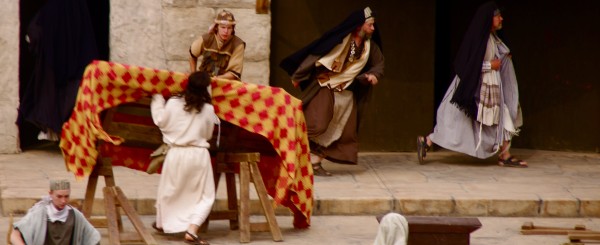
Oh how I wish Jesus had set a better example!
Let’s be reasonable here. He should have proposed his prophetic action in consultation with the religious leadership far in advance of the Passover feasts. This would have reduced so much stress for the Pharisees and scribes.
He shouldn’t have made his case using sacred scriptures. Too risky, too radical, too much playing his religion card like he knew it all. Why did he have to bring Isaiah or Jeremiah into this, crazy activists claiming God’s house for foreigners, eunuchs and the like! One issue at a time now! How dare he come to the temple with an agenda!
He certainly should have worked within the structures to ensure no one would be offended, no one would risk the chance at dialogue due to untimely, unvetted mention of certain outcasts. Didn’t he know that if you want to include these people, you have to exclude those people.
He should have toned it down at least a little, no name-calling nor blocking pedestrian traffic in the temple. And what’s with the whip of cords!?
Read more and get involved over at overturningtables.org!
CharlettaE
July 1, 2013
activism, Allyhood, Anabaptism, antiracism, Current Events, Exclusion, Gender, Group Identity, Immigration, Indigenous, LGBTQ, Mennonite Church USA, Peace & Peacemaking, Polarization, Power, Privilege, Race, Social justice, Spiritual Life
Read more >
Yesterday, on my way to take my ten year old son to camp, I was telling him my plans for the day.I was driving to Harrisburg from Philadelphia with a van full of Mennonites (white and non-white, citizens and undocumented) to oppose the attempts of some State Representatives to make it a crime to be undocumented.
My son’s response was surprising, and a little funny–“Mom, who invented power?And I’m not talking about electricity here!”I’ll admit that I was proud of his question and his outrage.I’m glad that he can recognize that power is being abused, and used to perpetrate violence and hate.
I reminded my son, who is prone to violent flashes of anger, that power is neither good or evil, what’s more important is the way you use the power you have.Case in point, a ten year old raging about needing to practice his cello certainly wields a lot of power in our house.So can his loving response to his little sister who just needs some big brother hugs.
I’m not the kind of person that meets with my state representative or writes letters to politicians.It’s not my style–I’m not articulate under pressure.I do better with some time to craft a statement, or in one on one conversation. But yesterday, I went to the Pennsylvania State Capital to support the Dream Act, and to oppose the attempts of legislators to make it more difficult for my undocumented friends to live in country we all love.I sat in hearings where we heard testimony from law enforcement, and from tea party activists, who called my friends “aliens”, “illegals”, and “those people”.They said that my friends didn’t care about this country, but only wanted to drain our welfare and social security system.They said my friends were murdering, raping, and stealing from citizens. The testimony was so distorted, so shockingly racist–I couldn’t make it up if I tried.
(more…)
AmyY
August 31, 2011
activism, Allyhood, antiracism, Immigration
Read more >

On Saturday, the Mennonite Church USA executive board decided to hold the MC-USA 2013 convention in Phoenix, thus saving the $300,000 deposit $460,994 (source: MCUSA staff) that otherwise would have been lost. Any delegates who feel unsafe (or uncomfortable) meeting in Phoenix due to Arizona’s targeting of the Latino community will be shepherded to a “satellite” gathering at an unspecified location. Thus, their marginalization will move from the realm of metaphor to a literal, physical fact. The decision is a real triumph of institutional logic.
As I read the news in my inbox this morning, I felt something inside me drop. I realized that I had let myself hope that the executive board might listen to the clear message from Iglesia Mennonita Hispana and many others. I had let myself hope that this decision would be different from the decision to move ahead with the building in Elkhart last year. I let myself hope that the institution could re-member itself as the beloved community and take a prophetic stand with a real cost.
If you’re looking for a further critique and de-construction of the decision, I recommend, Andy Alexis-Baker’s piece Becoming Anabaptist: A Protest to the Mennonite Church. I want to focus elsewhere in the remainder of this piece.
(more…)
TimN
January 10, 2011
Immigration, Mennonite Church USA
Read more >
Ever feel like you’re somewhere where you shouldn’t be?
Yesterday I was running on the Coal & Coke Trail outside Mount Pleasant when I found myself in the midst of hunting season in Western PA. Orange-clad hunters with rifles patrolled the woods on either side of the trail.
This isn’t abnormal this time of year…after all, the PA hunting season is short and the interest, strong (i.e. supply and demand sends hunters and the hunting-inclined out in droves), and I’ve certainly seen hunters out and about during my daily runs.
But I felt particularly vulnerable this time around.
Yeah, I was wearing bright red and running in a b-line down a wide jogging trail, and I realize that hunters for the most part are very careful with their rifles. Most of the hunters I saw even acknowledged me with a hand wave or a tip of the cap.
(more…)
BrianP
December 13, 2010
Bigotry, Gaza, Illegal, Immigration, Iraq, Israel, LGBTQ, Palestine, Peace & Peacemaking, Urban MinistryBullying, CARE International, CCIR, Christian Peacemaker Teams, Fear, It Gets Better, MCC, Peace & Peacemaking, Play4Peace, Violence, Watoto
Read more >
I live in Phoenix, the front line in the war against the tired, poor, and huddled masses yearning to be free. I would imagine everything here looks pretty awful from the outside, seemingly without a silver lining, but I’ve been seeing something different, something beautiful happening here.
In the midst of our police raids, our masses of children orphaned by deportation, women giving birth in shackles, and our racist legislation, something wonderful is happing in the heart of the church. People from all sides of the religious spectrum are coming together in a way I haven’t ever seen before to “do justice, love mercy, and walk humbly with our God” (Micah 6:8).
And it’s beautiful.
 A friend of mine and I went to a meeting of clergy recently, gathering to discuss what we as a church can do. We met in the chapel of a United Church of Christ congregation downtown and had everyone from pastors and priests with their collars to rabbis with their yarmulkes, Muslim women in their hijabs and a few Anabaptists with babies in slings across their chests. Throw in a few Buddhist monks, devout Hindus, Unitarian Universalists, Baptists, and everyone in between and you’ve got a good idea of what the average immigration reform demonstration looks like here.
It’s a rainbow of beliefs putting our differences aside and uniting in the belief of a God without borders, without nationality, and who cares more about someone’s well being then their legal status. I have in my mind an image of God looking down on us and repeating the phrase “It is good.” as he did in the creation story in Genesis.
The hardest thing about SB1070 and similar hate based legislation is that politically, in a lot of ways, they makes sense. But I believe that we are called to do something radically different when we decide to follow Jesus. Jesus’ teaching didn’t make sense. Loving your enemy, praying for those who persecute you, turning the other cheek, these things don’t make sense at all… and that’s part of what makes it so fantastic.
Believing in Jesus is believing that doing what doesn’t make sense can be the best thing, and that sometimes doing what doesn’t make sense is what makes a better world possible. I believe in that world and I want so badly to be a part of it.
JennaBoettger
July 28, 2010
antiracism, Bigotry, Church, Current Events, Illegal, Immigration, Politics, Race
Read more >
For Holy Thursday a bunch of gathered at an Immigration and Customs Enforcement (ICE) detention center in Cary, North Carolina, and held a footwashing worship service–we told them we wanted to wash the feet of the people detained inside. If you haven’t heard about these ICE detention centers, that means the federal government is good at what it does: Obama is turning out to be just as good as Bush in keeping secrets from U.S. citizens. ICE sets up field offices in unmarked buildings, tucked away in business parks throughout suburbia. Once citizens find out about a particular site, ICE closes up shop and moves to another unmarked building, tucked away in one of the other many business parks in a different suburb. The detention center in Cary we visited is next door to the offices of Oxford University Press, the publisher of many of the books on my shelves. (For more information on ICE detention centers, read this article from The Nation: America’s Secret ICE Castles).
Here’s some local media coverage of our worship service and protest: “Protesters hold demonstration,” and “Taking the Cross to the streets.”
And here’s an excerpt from the short sermon I preached at the detention center as a Cary police officer kept telling me to stop preaching and leave the premises:
This chair here will remain empty as a sign of all the bodies that the department of Immigration and Customs Enforcement have hidden from us, the bodies that law enforcement agents have torn from our communities and our families in the middle of the night, the bodies that they have ripped away from our churches. By refusing to let us wash the feet of the people hidden in their detention centers, the federal government has dismembered the body of Christ, they have torn apart the church, they have pierced and severed the body of Jesus.
For the rest of the sermon, follow this link to my church website: “Bodies Matter, part 1”
IsaacV
April 2, 2010
activism, Anabaptism, Discipleship, Illegal, Immigration
Read more >
New Heaven, New Earth: Anarchism and Christianity Beyond Empire
August 14 & 15, 2009
Location
Caritas Village
2509 Harvard Avenue,
Memphis, TN 38112
This year’s anarchism and Christianity conference, hosted by Jesus Radicals, will look squarely at the economic and ecological crisis facing the globe, and point to signs of hope for creativity, for alternative living, for radical sharing, for faithfulness, for a new way of being. We are living in a karios moment that will either break us or compel us to finally strive for a new, sane way of life. The question we face at this pivotal time is not if our empires will fall apart, but when they will fall–and how will we face it? We hope you will join the conversation. (more…)
ST
June 25, 2009
activism, Anabaptism, Awesome Stuff, Change, Church, City, Civilization, Clothing, communication, Community, Conscientious Objection, Consumerism, Contemplation, culture, Current Events, Discipleship, Economics, Education, Emerging Church, End Times, Environment, Ethics, Evangelism, Faith, Family, Gender, Global Church, God, Group Identity, Healthcare, History, Immigration, Indigenous, Interfaith, International Relations, Leadership, liberation theology, Mental health, New Monasticism, Nonviolence, Peace & Peacemaking, philosophy, Polarization, Police, poverty, Power, Prayer, Privilege, Race, Roman Catholic, Spiritual Life, Stewardship, Stories, submergent, Television, The Bible, Theology, Tolerance, Tradition, Travel, Urban Ministry, war, Wealth, Writing, Young Folks
Read more >
crossposted from As of Yet Untitled
On Thursday evening Charletta and I watched The Visitor. Charletta and I watched the The Visitor last night. Friends had recommended it and I expected a quirky, lovable independent film. It’s this, but it is also a devastating portrait of ICE detention centers from the inside and draws us into the story of the way they tear apart families and dehumanize people. Yet its not a depressing film. It combines gritty honesty and playful hope in an strikingly un-Hollywood way.
After the film finished, I thought of my friend Anton Flores (see my profile of him from last fall) whose life work is supporting those who have become ensnared in the immigration system. The next morning I woke up to an email from Anton describing his DriveFast, in which he will abstain from driving at all during Lent. His pledge, however, isn’t just motivated out of green sensibility. Instead it points to the way drivers license restrictions are used to control and dominate undocumented workers in the small town in Georgia where he lives. He’s told me stories of standing besides immigrants as they are belittled by judges for driving without a license, even as they embody the system that is taken that right away. I stayed with a family in his neighborhood who must drive every day without a license because they have no other way to get to their job. They live in constant danger of being pulled over and possibly deported (more…)
TimN
March 1, 2009
Immigration, Reviews, Spiritual Life
Read more >
(A Debbie Downer post. Sorry about your luck.)
For several months I’ve been making posts that suggest (though I don’t think I’ve said it), that the idea that people are somehow different than they were before is probably a little idealist. I don’t think people are progressive (as in, moving forward or evolving either physically or emotionally/spiritually/physcologically). Perhaps the best time I’ve come out and said it would be the shit-disrupter of a post I made on Christarchy, Humanity on the Fringes of a Moshpit. Essentially, in a long winded tirade, I compare the progressive anarchist/art-school kids to the famed large browed Geico Spokesmen. Such a thing was a dare, especialy among my more liberally minded brethern. But I did it. I did it because I don’t think humanity is really all that different than it was 2,000 years ago. Or 4,000. Or 6,000. We can pretend lots of things, like those people back then were all stupid, ignorant, inbred maruaders, raping the land for everything it was worth. Besides for the inbred thing, I don’t think we are far removed. (more…)
somasoul
January 26, 2009
Death, Dumb Stuff., Foreign Policy, Gender, Illegal, Immigration, International Relations, Military, Power
Read more >
Crossposted from As of Yet Untitled
I’m in the midst of a 5 day stay in LaGrange, Georgia hosted by the Alterna community as part of the Christian Peacemaker Teams steering committee meetings. Today I had the opportunity to interview Anton Flores, one of the founders of the community.
Anton has lived in LaGrange for 15 years and for 10 years he taught at LaGrange College. Today his full time, unpaid works is with Alterna. During the week, I’ve noticed he is often on his cell phone as he recieves calls from people in crisis. Whether it is legal, health related or housing crisis, Anton help Latino immigrants navigate the situation in this small town of 28,000.
A significant portion of Anton’s time is spent helping people caught in the legal system. Anton goes to court every week as an advocate for local Latinos who have been fined, most often for driving without a license (it’s impossible for those without documents to get one in Georgia). Anton estimates fines paid by immigrants and low income people in LaGrange each year to be at least $125,000, a sizable contribution to local government by a group that makes up only 5-10% of the population.
Last year Anton set up an office in a local Hispanic grocery so he could get to know the community. The arrangement was so successful in connecting with the Latino community, that he no longer needs to go looking for work. His work finds him on his cell phone wherever he is.
But Anton isn’t only content to fight fires. He also challenges the system that creates these crisis. In our conversation he described the paradoxes of the system that depends on undocumented immigrants for labor even in building military barracks and the LaGrange courthouse. Anton pointed to the way Atlanta heavily recruited Mexican immigrants as labor in the years before the 1996 Olympics as they struggled to make deadlines. Though the system needs the laborers, they are the ones forced to take all the risk. Along with crossing the border without documentation, they also must find false documentation. Anton described his experiences doing courtroom advocacy in which he watch a judge mock those who used false names in a way that made them out to be liars and untrustworthy. In reality, they were hard working, honest people forced into fraud by the system that needed them.
(more…)
TimN
October 6, 2008
Immigration
Read more >
This piece was originally published in the AMIGOS Update for Mennonite Church USA and Mennonite Church Canada for May (see their archive for more info about AMIGOS).
“To authentically respond to immigration,” according to the recent MCC US Immigration Listening Report, “whites must start by seeing immigrants as ‘us’ instead of ‘them.’ White communities and churches who until now have taken little action on behalf of immigrants, must start viewing newcomers as esteemed members of God’s family — just as deserving of justice and love as church friends and immediate family members.”
How do those of us then, who fall into this category, work toward a change in perspective? Could it be that we Mennonites of European descent have forgotten our own history? Perhaps in comparing current themes — government guidelines for immigration, stereotypes faced by recent immigrants, and the role of economic instability in causing people to leave their homes — to our own immigrant histories, the categories of “us” and “them” may become much less distinct. Although the family stories of long-time immigrants are not identical to what is happening today, our history connects us in striking ways with the stories of recent immigrants.
Therefore, as we engage the narratives of our past, first we move to Switzerland in the seventeenth century where government officials did their best to suppress the Swiss Mennonites through heavy fines, land seizure, the threat of capital punishment, and deportations. John Roth notes in Letters of the Amish Division, how a few decades later some Mennonites “defied the mandates and threats of the Swiss government and secretly returned to Switzerland to rejoin their families or to claim their possessions.” (more…)
Joanna
June 10, 2008
Bigotry, History, Immigration, Polarization
Read more >
I don’t really like calling people names like “stupid” but the title was too much too resist. My apologies.
I was discussing the gentrification of Baltimore recently online. I understand concerns about urban gentrification and I partly agree with them. I can certainly understand wanting to keep neighborhoods in the hands of neighbors, not gianormous corporations and urban planning bureaucrats trying to utilize Eminent Domain to kick people out of their homes.
Part of our discussion centered, and others I’ve had, with the systematic racism of Baltimore in particular. It got me thinking about racism more, a topic which most of you know I could really care less about. (more…)
somasoul
May 13, 2008
activism, Bias, Bigotry, City, Dumb Stuff., Economics, Group Identity, Hate, Illegal, Immigration, Polarization, poverty, Privilege, Race
Read more >
Katie
March 27, 2008
culture, Healthcare, Immigration, poverty, Power, Race, Wealth
Read more >


